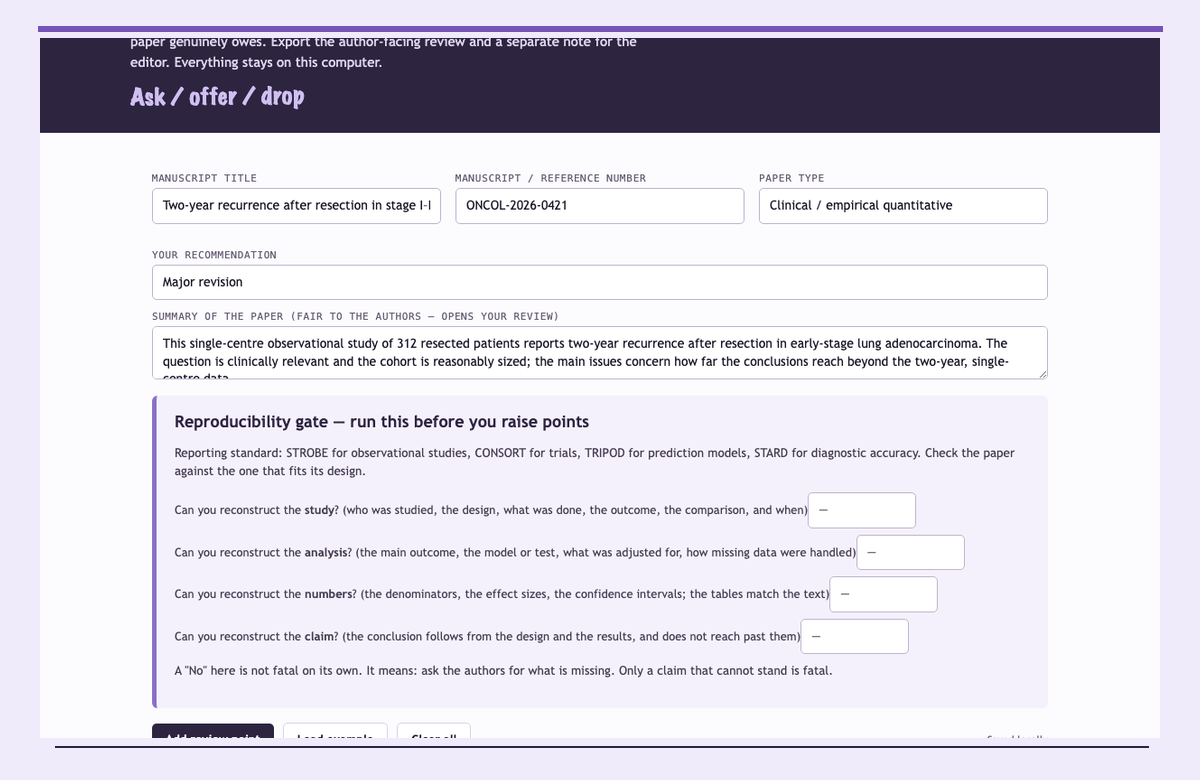
Comment eight may be a flaw. Or it may be your paper, not theirs.
The hard part of peer review is not finding more things to criticise. It is deciding which findings matter, which can be fixed, and which should never become demands.
A fair review is specific enough for the authors to act on and clear enough for the editor to understand your recommendation.
Start with what the paper claims
One path from reading to recommendation
Reconstruct the paper
Name the paper type, central claim, study, analysis, and numbers before raising points.
Locate the problem
Map each criticism to a sentence, table, figure, or method choice.
Classify it
Separate a fatal flaw, major fix, minor issue, editorial suggestion, preference, and discipline mismatch.
Test the demand
Check whether you are asking for impossible new data, the wrong standard, or simply your preferred design.
Write both notes
Export the author-facing review and a separate confidential note for the editor.
A review point has somewhere to go
The Notebook does not reward a longer list. It helps you decide what to ask for, what to offer as optional, and what to drop.
State what is wrong, where it is, and what would make the paper assessable or defensible.
Mark it as optional. Do not make publication depend on your preferred wording or citation.
Keep it out of the review when it does not change whether the claim can stand.
Would you sign it?
Every retained point passes seven integrity questions, including whether it maps to the paper and whether you would put your name beside it.
Inside the download
Six ordinary files. No account and no manuscript upload.
reviewers-notebook.pdfThe 12-page field guide: reproducibility, paper-type standards, statistical consistency, claim-evidence audit, reviewer traps, triage, language, and final integrity check.
review-triage.htmlThe local browser tool. Classify points, check the traps, build the ordered review, and export the confidential editor note.
quickstart.pdfThe shortest route from opening the manuscript to a review you can submit.
worked-example.pdfThe same invented paper reviewed poorly and then reviewed fairly, so the difference is visible.
field-checklists.mdTickable decision lists for Notion, Obsidian, or print.
LICENSE.txtPersonal use. Group, journal, teaching, and facilitation licences are available on request.
Private by design. Limited on purpose.
What stays on your computer
The HTML tool makes no network requests and stores its working state in your browser.
Export plain text or Markdown when the review is ready.
What stays yours
The journal's criteria and your expertise take precedence.
Do not upload a manuscript under review to cloud AI or another service unless the journal explicitly permits it.
Peer review has two desks
Writing the response instead?
The Reviewer Response Builder is the author's side: every comment beside the answer, real change, and manuscript location.
Get the Reviewer's Notebook
Six files, instant download, personal licence, and every v1.x update. EUR 39 launch price; regular price EUR 59. A 14-day refund applies if it does not change how you write at least one review.
Practical questions
Does the tool review the paper for me?
No. It helps you reconstruct the paper, classify your own points, spot reviewer traps, and assemble your words. The judgement and recommendation remain yours.
Will it work offline?
Yes. The Review Triage tool is one HTML file that opens in a browser without an account or internet connection. The other files are PDF and Markdown.
Is it only for medical research?
No. The worked example is clinical, but the paper-type routing and decision method cover quantitative, qualitative, diagnostic, prediction, and evidence-synthesis work.