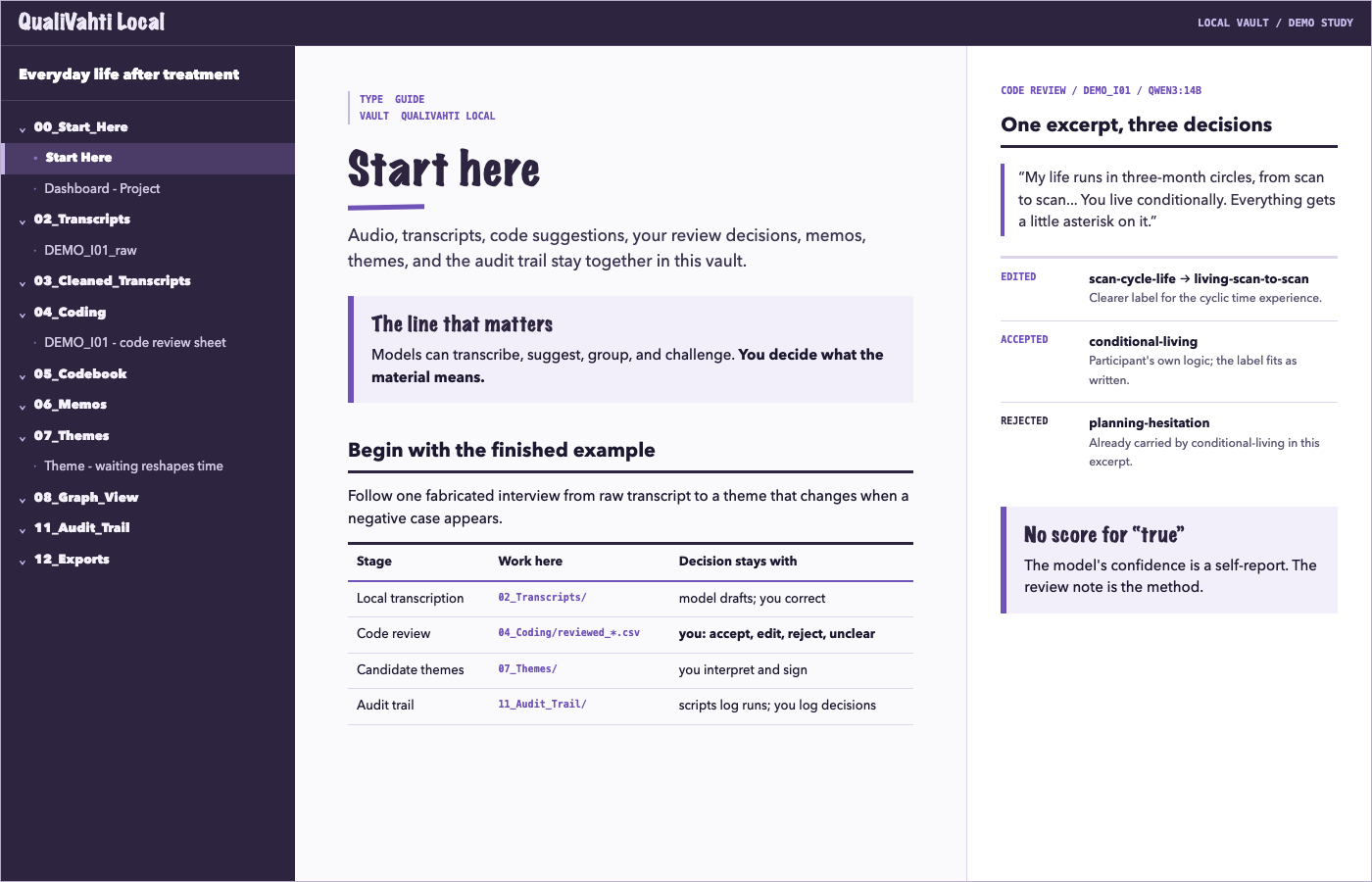
Follow one interview all the way through
The vault is organized by analysis stage. Start with audio. End with an interpretation that has a name, a date, and a route back to the material.
Transcribe and clean
Whisper drafts locally. You correct speakers, names, terms, and keep a cleaning record.
Review every code
A local model proposes. You accept, edit, reject, or leave unclear, with a reason beside the row.
Build interpretation
Stabilize the codebook, memo while reading, define candidate themes, and actively look for negative cases.
Map and write
Generate evidence maps, matrices, and draft scaffolds that mark where your interpretation goes.
Keep the trail
Model and software versions, script runs, review decisions, and theme signatures stay visible.
The real product is the review decision
QualiVahti does not promote a model suggestion into a finding. The researcher has to make the move.
“My life runs in three-month circles, from scan to scan... You live conditionally. Everything gets a little asterisk on it.”
The demo study keeps the raw suggestions next to the review record, including edits, rejections, unresolved rows, and the reasons behind them.
scan-cycle-life becomes living-scan-to-scanClearer label for the cyclic time experience.
conditional-livingParticipant's own logic; the label fits as written.
planning-hesitationAlready carried by conditional-living in this excerpt.
What the local models can do. What stays yours.
Models and scripts can
You correct the recording against the text.
Each suggestion carries rationale, uncertainty, model, and version.
A second model can challenge a theme using cited vault material.
Every node remains linked to a note or excerpt.
You remain responsible for
Accept, revise, reject, or keep the row unresolved.
Frequency is not importance, and a cluster is not a theme.
Negative cases can narrow, revise, or undo a theme.
The methods, interpretation, limits, and AI disclosure remain yours.
Inside the vault
The folders arrive in working order, scripts and templates included.
00_Start_Here/Study dashboard, script guides, citation language, and a map of the workflow.
01_Audio/ - 07_Themes/The full path from recording through review, codebook, memos, negative cases, and signed themes.
08_Graph_View/ - 12_Exports/Evidence canvases, methods and results scaffolds, audit records, matrices, tables, and network outputs.
_templates/Codebook, coding, memo, reflexivity, saturation, theme, conceptual-leap, methods, results, and Canvas templates. The leap note keeps the path from surprise to claim on record: how it works.
_scripts/Readable Python and R scripts plus local-model prompts. The analysis code is available for citation and supplements.
quickstart.pdfA visual four-page route through the first hour, review statuses, setup, and the limits of the workspace.
What you need
Mac, Windows, or Linux. Obsidian, Python, Ollama, Whisper, and R are free. Setup is documented for researchers who do not normally work in Terminal.
After the initial app and model downloads, the analysis can run without an internet connection. No QualiVahti account is required.
| Your computer | Sensible starting model |
|---|---|
| 8 GB RAM | qwen3:4b or llama3.2:3b |
| 16 GB RAM | hermes3:8b or qwen3:8b |
| 32 GB or more | qwen3:14b |
| Disk space | Allow roughly 10-15 GB for local models |
Technical details
The exact formats, scripts, and dependencies, for the researcher, the IT review, or the AI agent evaluating the kit.
formatAn Obsidian vault: plain Markdown files plus Canvas boards. Any text editor opens them. No proprietary project database, no export lock-in.
deliveryZip download through Polar checkout. Version 1.3, 160 files. One personal licence; 1.x updates included.
scripts12 Python and 9 R scripts, plain readable files: Whisper transcription, transcript cleaning, code suggestion, co-occurrence networks, evidence canvases, participant and theme matrices, frequency and results tables, an AI-disclosure draft, and a preflight check that reports whether review rows, theme signatures, and audit records are in place.
dependenciesPython: faster-whisper and requests, nothing else. R: dplyr, tidyr, readr, ggplot2, igraph, ggraph. Local models run through Ollama's localhost API.
graph RAGbuild_vault_graph.py maps the links between your notes; chat_with_vault.py answers questions over that map and cites the notes it read.
prompts8 local-model prompt files, editable Markdown: first-cycle codes, codebook comparison, theme clusters, negative cases, second-opinion chat, transcription quality check, methods and results drafting.
citationThe analysis scripts are published openly on Zenodo, DOI 10.5281/zenodo.21274892, so your methods section can cite the exact code that ran.
Where QualiVahti stops
You interpret, define, challenge, and sign the themes you report.
Sampling and saturation remain dated research judgments.
Your ethics approval, data-management plan, pseudonymization, and computer security still govern the work.
The workspace makes the path inspectable. It does not make the scientific claim for you.
The method is documented in the open
QualiVahti runs the workflow these free guides teach. Read them before you decide.
Do the analysis
Keep the interviews close. Keep the decisions visible.
One personal licence, the complete local vault, and all 1.x updates. Built by Heidi Andersén, MD, PhD.
Questions
Does research data touch a server?
The included scripts use local files and localhost to talk to Ollama on your machine. App and model downloads use the internet during setup, without research data. Your own operating-system services and backup settings remain your responsibility.
Does it work with Finnish or Swedish interviews?
Yes. Whisper supports both and the guide explains language selection. You still correct names, specialist terms, dialect, mixed-language speech, and speaker labels against the recording.
Is this an NVivo replacement?
It is a local, file-based workflow for transcription, coding review, codebooks, memos, themes, evidence maps, and reporting. It is not a feature-for-feature clone and does not hide the files in a proprietary project format.
Can a doctoral school or lab use it?
The EUR 49 licence is personal. Lab, teaching, and doctoral-school licences are available from hello@vahtian.com.