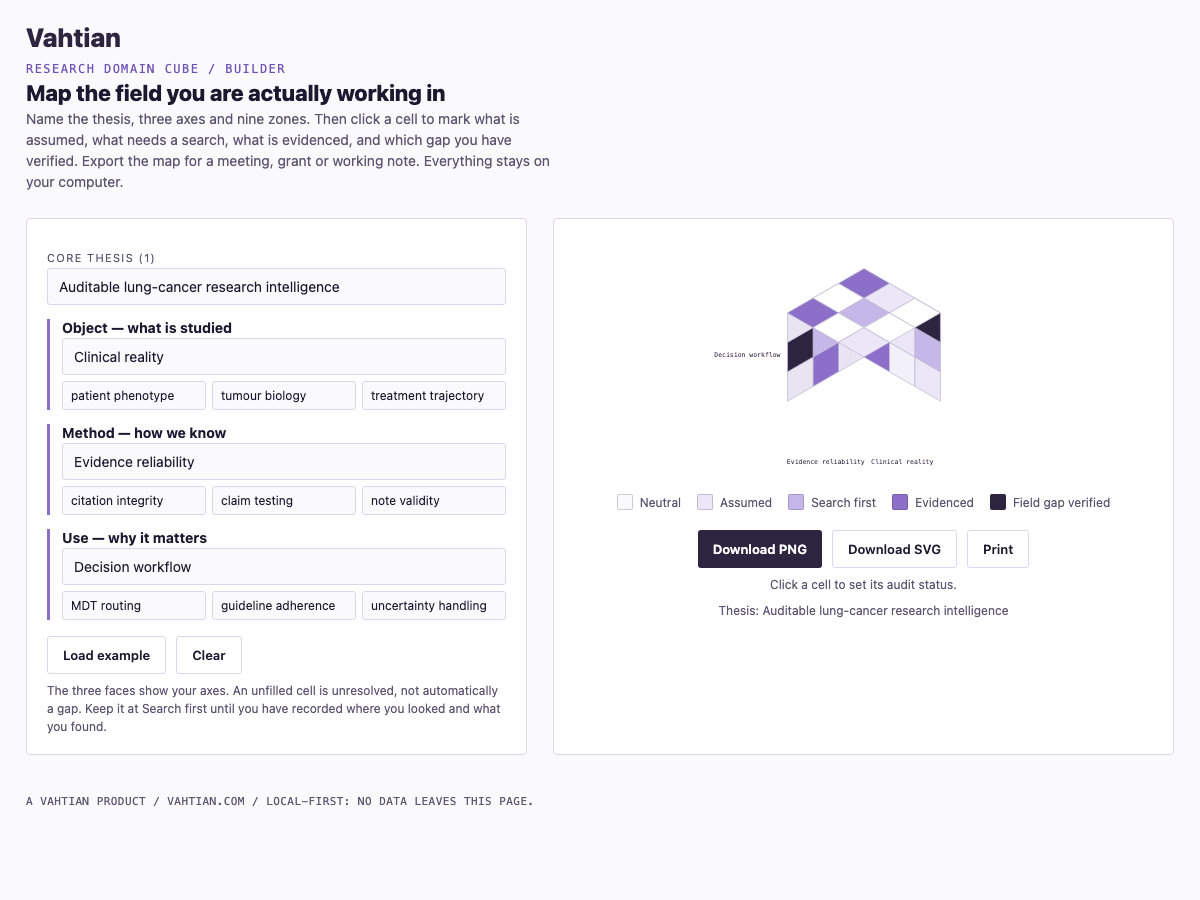
Start with the work already on your desk
A research plan often begins as a pile: one promising dataset, two unfinished papers, a grant idea, and several questions that may or may not be new. The cube gives that pile a shape you can inspect with a supervisor, collaborator or team.
01 / MAP
Build the field
Write one core thesis, three useful axes and nine zones. Split the zones into 27 concrete project moves.
02 / AUDIT
Mark what supports each cell
Separate evidence from assumptions, searches still to run, and gaps verified through a documented search.
03 / CHALLENGE
Compare the candidates
Score importance and feasibility. Then read the sources, question the scores and make the decision yourself.
What comes out of it
Not a verdict. A short list worth discussing.
Paper candidate
A useful project with evidence in hand and a realistic route to completion.
Grant candidate
An important project that needs people, access, data or time you do not yet have.
Gap candidate to verify
A question that remained open after a named search. It is still a candidate, not proof that nobody has done the work.
Inside the kit
research-cube-workbook.docxBuild the thesis, axes, zones and cells by hand, with space to challenge the map.
project-cell-planner.xlsxScore 27 cells, keep source and search evidence beside them, and surface three candidates.
cube-builder.htmlMake and export your cube as PNG or SVG. It runs offline and sends nothing anywhere.
quickstart.pdfA concise route through the method and the files.
worked-example-lung-cancer.pdfA complete clinical example, including unresolved cells and a deliberately missing source.
domain-cube-prompt-pack.mdOptional prompts for asking AI to challenge the map and prepare searches.
Where the kit stops
It is not a literature review
The map helps you decide where a review or search is needed. It does not replace one.
It does not establish a gap
An empty cell may mean the axis is weak, the search is unfinished or the question is poorly framed.
It does not choose the project
The scoring narrows the field. You remain responsible for scientific value, feasibility and consequences.
Map the field. Then argue with the map.
Six working files, one personal licence and all 1.x updates. Built by Heidi Andersén, MD, PhD.
Questions
Do I need AI to use it?
No. The workbook, planner and cube builder work without AI. The prompt pack is there when a skeptical second reader would help.
Can AI fill the cube for me?
It can suggest wording, counterexamples and searches. It cannot supply your scientific judgment, verify a source or establish a field gap.
Does it only work in medicine?
No. The structure is field-neutral. The worked example is clinical because that is the research practice the kit came from.
Is it a subscription?
No. It is a one-time EUR 29 digital download.